
Living the raw material
Dark and light, it all goes into the rag bag


Hello from Brooklyn, where the humidity is 81 percent. My god, this has been the summer of sweat. If this carries on much longer, I am going to turn into an eel.
I just flew in yesterday from London, where I spent all of July and celebrated my daughter’s thirtieth birthday. Thirty?! How can I be the parent of a thirty-year-old? The salesgirl in the Notting Hill boutique where I was browsing for a birthday gift asked what age my daughter was turning, and after a pause, I just said: “She’s an adult.” This will be my stock answer to that question from now on.
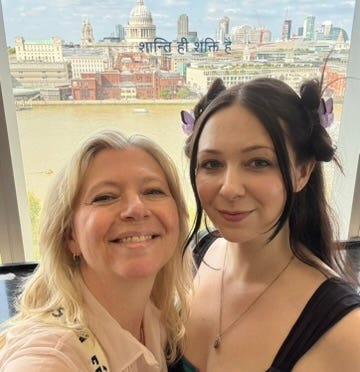
In her birthday card, I wrote: Congratulations on slamming the door shut on your twenties.
My daughter and I are very different people, but we have this in common: we both had a miserable youth and young adulthood. (Yes, I recognize this does not reflect entirely well on me as her mother — but neither would pretending otherwise.)
When I was pregnant, my dad said to me, “Everybody thinks they can avoid fucking up their kids if they can just avoid making the same mistakes their parents made. But you can’t, because you’re going to fuck them up in ways that you never saw coming.”
True. And, honestly, a bit rich coming from him.
I used to resent my tragedy-stricken childhood, but now I see it as a blessing. My life has gotten steadily sunnier and more peaceful over the years, and I’m still on the upswing. I know several people whose lives moved in the opposite direction: a blissful childhood, twenties that sparkled with possibility, then a steep slide downhill as life failed to deliver on that early promise. I don’t envy their trajectory. It’s useful to have a very low “worst of times” in your past to benchmark against.
And, of course, all that trauma gives you material to write about.
Last week, I coached a client who is at a crossroads with her manuscript. Initially, she’d intended to write a how-to book. But as she dove into the writing, what came out was 80,000 words’ worth of intensely personal stories about the tough times that shaped the person she is today. Writing those stories was profoundly cathartic for her. But what should she do with this accidental memoir? Revise it toward publication or put it in a drawer? Did she need to get over her fear of sharing her story? Or is it not meant for sharing at all?
I told her that our trauma stories play a crucial role in the development of a writing practice in ways that have nothing to do with publication potential.
When I first emerged from creative paralysis a few years ago, it was those deeply embedded trauma narratives that demanded to be written first. The family-shattering tragedy of my sister’s death in childhood. The terror of raising a small child as an insecurely housed single mother. Breast cancer. Addiction. It’s all in the archives of this Substack.
Eventually, I hit a point where all my “greatest hits” had been played. What do I write about when the closet is cleared out of skeletons? Do I even have any stories beyond: “This awful thing happened to me”?
What I now know is, of course, I do. We have so much to say beyond our trauma narratives. But they may have to come first. (I did a deep-ish dive into the purpose of trauma writing in a recent Wonderwell email; you can read it by signing up for that list with this special link.)
As for my daughter, it might not surprise you to learn that she writes, too. In April, I was with her at the launch of her first book, a poetry chapbook called Little Black Engine, published by Slub Press. And last Friday, I was in the audience as she read a short story in the Soho Reading Series. Insert comment about apples and trees if you want, but the fact is, she is a far more literary writer than I’ll ever be. If the two of us were books, she’d be shelved in the poetry section; I’d be in self-help.
I am in a weird place with my writing. Since delivering my manuscript six weeks ago, I’ve really let my practice slide. Too busy having fun with my London people. Now that I’m in New York with a generous friend’s apartment all to myself, I am planning to lean into solitude and recalibrate creatively. And yes, I get the irony of running to New York City to find some alone time.
What will I write about, now that I have no book deadline to work toward? My Notes app is full of essay ideas, thoughts about aging while female, and moments from this itinerant year, possibly for the (gasp) next book. I have no clue what shape it will take. I’m just collecting textures and colors like a rag bag for a someday quilt.
Recently, I was talking with a friend who is living through a protracted liminal space too, navigating her mother’s slow decline and approaching end of life. I said to her: You and I are both living our raw material, right now. We will write about all of this one day. First, we have to go through it and see where we find ourselves when we pop out the other side.
Coach with me
If you have struggled to get traction in your own writing, I want you to know that it is waiting for you. No matter how long you’ve been away from your writing practice, or “getting around” to starting a writing practice for the first time, nothing is wasted, nothing is lost.
Your fantastical stories, your first-person essays, your poems—they’re inside you now, patiently standing by for the moment you are ready to call them forth.
It isn’t a lack of discipline getting in the way, or a lack of ideas, or talent. Right now, you have an abundance of talent and ideas, and all the discipline you need to unlock them. (It’s not really about discipline, anyway.) What’s getting in your way is that you don’t know for sure that the time, effort, and emotional risk required to write will “pay off”. And that is a worthiness issue.
You don’t need accountability structures and productivity hacks. You just need the courage to try. Permission to falter. And maybe a little guidance to get you going.
I have two spots open for one-on-one creativity coaching. My rate is $250 USD per hour.
Book a 15-minute vibe check with me to find out if it’s a fit.